

4 Million Developers

Cloudinary hit a big milestone: 4 million developers and 13,000 brands. I led the campaign to celebrate it from start to finish, including an interactive landing page, ads, social assets and reels.
Cloudinary hit a big milestone: 4 million developers and 13,000 brands. I led the campaign to celebrate it from start to finish, including an interactive landing page, ads, social assets and reels.
Building on 3M
On the 3 million developer campaign, I played a supporting role, executing the vision of my previous creative director, someone I greatly admired. I brainstormed with her during early ideation, then created all of the motion graphics, handled the design, layout and production, and edited all of the reels. That's where I learned what makes a milestone campaign different: it grows out of the original brand, but because it's a celebration, it gets to stand out a bit more than our everyday work.
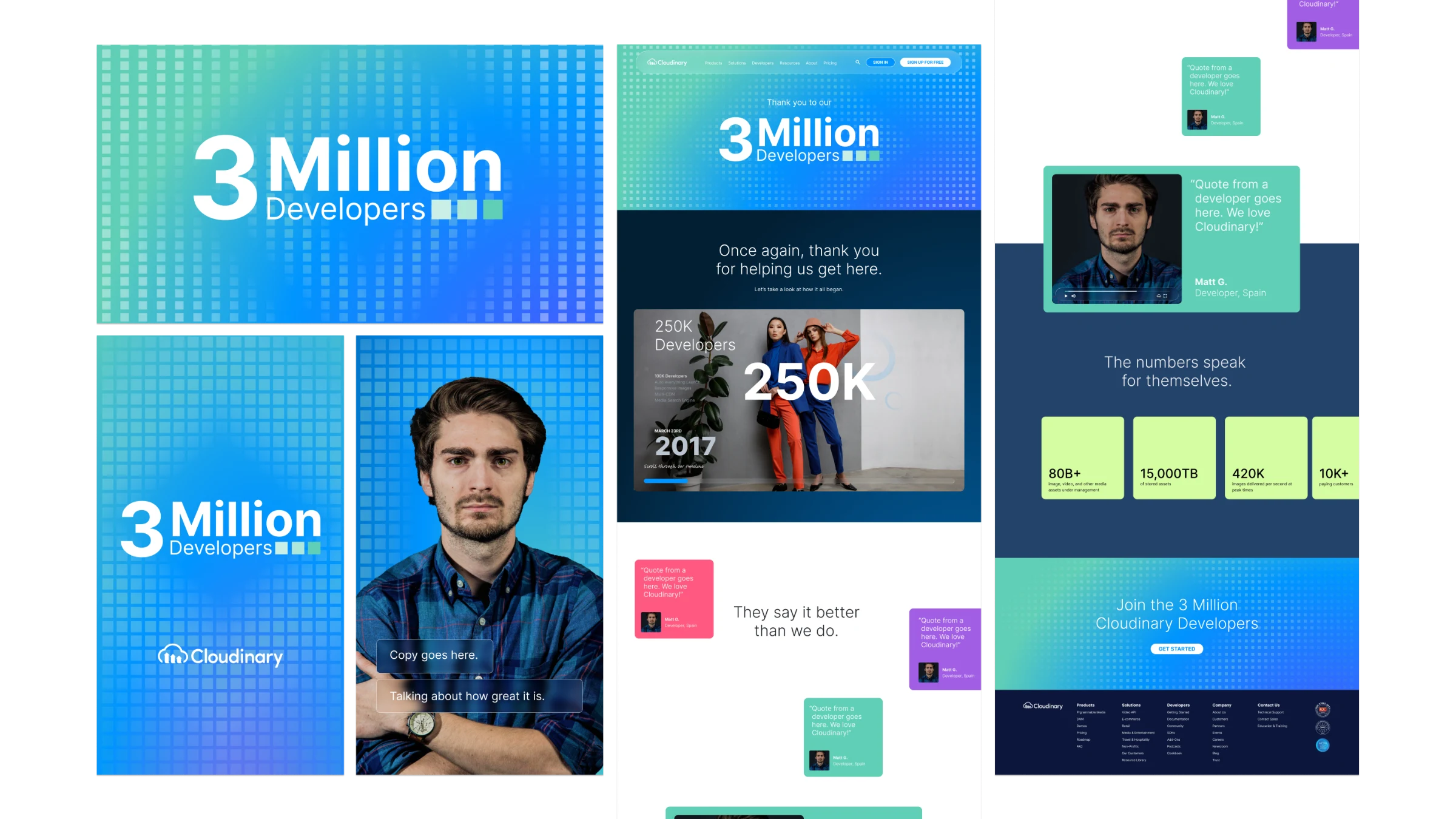

Finding the direction
I started by analyzing 3M through my previous creative director's moodboard, then explored several directions with stakeholders before landing on the pixel grid. Once it clicked, I refined it into the "4M" logo and the "every 20 seconds" motion, then grew it into the full system: demand gen and enterprise ads, social, and reels featuring real developers from around the world.

One user, one pixel
This year, I wanted to focus on how big and expansive our user base has become. I started with Cloudinary's existing pixel motif and made each pixel stand for one user. Thousands of them come together on one grid to tell the bigger Cloudinary story. Each tile stays in place and only grows or shrinks, so the energy moves through the grid while the tiles stay put. For the campaign's "4M" logo, I chose Baskerville, a classic serif, and rebuilt it in pixels. I wanted to pay homage to the design giants who came before us, which felt right for a celebration. A classic typeface also brings some humanity to something so technical.
Finding the motion
We got stuck on the motion. We wanted it to feel alive without being gimmicky, to be unique, and to say "huge user base" without looking like generic AI-generated motion. Thinking about speed and growth reminded me of how slime mold once recreated Tokyo's rail network, and that was my aha moment. Slime mold grows as one connected organism, and it has an organic look and movement. In the animation, tiles gather into hot spots that travel and merge until they form the "4M," and later a map of the world. It fit a community that keeps growing together.
Same idea, new audience
Partway through, the goal changed. To hit our signup targets, the campaign needed to speak to enterprise buyers, not just developers. I worked with stakeholders and messaging specialists to reframe the story, so 4 million developers became proof that Cloudinary works at enterprise scale. The visual system held up, so we didn't have to rebuild it.
Built to iterate
Animating thousands of tiles by hand wasn't realistic, so I wrote After Effects scripts that animate every tile from a set of rules. To change the timing, I could adjust a few values instead of thousands of layers, which let us iterate quickly with stakeholders. The scripts did the heavy lifting, but I tuned every creative decision by hand: the timing, the easing and the feel of the movement. Everything shipped as lightweight Lottie files for the web.

